

The Complete Guide to Old European Cut Diamonds
Introduction
Having worked in the diamond trade for more than twenty years, as part of a family of diamond merchants spanning several generations, I have witnessed the remarkable resurgence of old-cut diamonds. Although these diamonds have always been appreciated by collectors and connoisseurs, it is only over the last decade that they have truly returned to the spotlight, becoming increasingly sought after by both collectors and those searching for unique engagement rings.
The evolution of diamond cutting is the result of many different factors. If I had to summarise them, I would highlight four main influences: the global supply of rough diamonds, the nature of the rough crystals themselves, changing jewellery fashions, and the continuous evolution of diamond-cutting techniques.
Today, the round brilliant cut is unquestionably the world's most popular diamond cut. However, this has not always been the case. Its dominance is the result of centuries of technical innovation and changing aesthetic preferences.
During the second half of the twentieth century, the primary objective of diamond cutting became the pursuit of maximum brilliance. As cutting technology advanced, craftsmen were increasingly able to produce diamonds with exceptional precision. The modern round brilliant, with its 57 facets, gradually became the international standard because it offered the greatest return of light.
This revolution owes much to Marcel Tolkowsky, the Antwerp mathematician and diamond cutter who, in 1919, published his famous calculations describing the ideal proportions for a brilliant-cut diamond. Although his work quickly became influential, it was only after the Second World War, as modern cutting equipment became more widespread, that these proportions became the industry standard.
Before that period, diamond cutters approached their craft very differently. Their goal was not simply to maximise brilliance. Instead, they sought to create beautiful, harmonious stones while working with the natural shape of each rough diamond. Cutting was far less standardised than it is today, and every craftsman brought his own experience and judgement to the process.
This is precisely what gives old-cut diamonds their enduring appeal. No two stones are exactly alike. Each possesses its own proportions, personality, and character—qualities that are difficult, if not impossible, to reproduce in the precision-cut diamonds of today.
A Brief History of Diamond Cuts
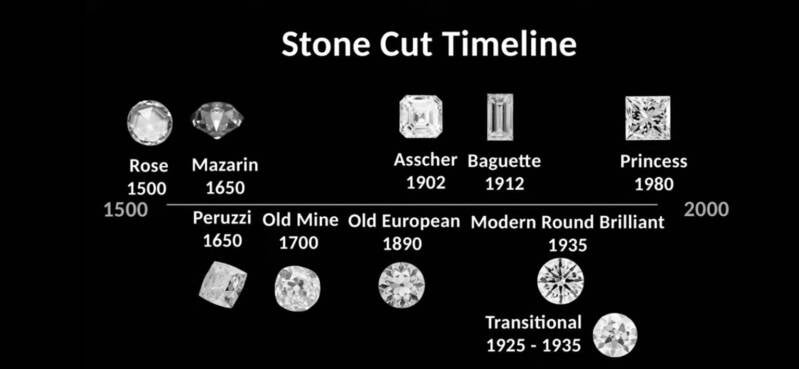
The timeline below provides a simplified overview of the evolution of diamond cutting. While it highlights the major milestones, the complete history is far richer and extends beyond the scope of this guide.
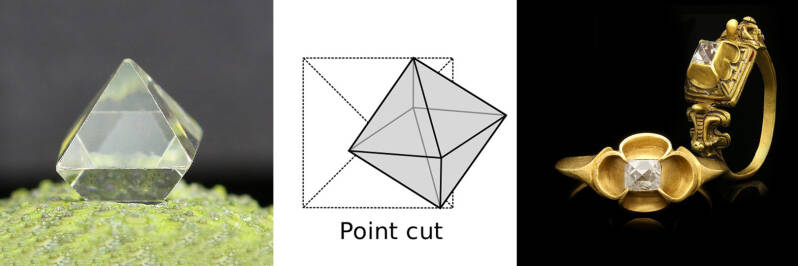
The earliest true diamond cut was the Point Cut, which appeared during the 14th and 15th centuries. Strictly speaking, it was not really a cut in the modern sense, but rather the careful polishing of the natural faces of an octahedral diamond crystal—the most common shape in which rough diamonds occur in nature. The purpose was not to increase brilliance but simply to improve the stone's natural lustre while preserving as much weight as possible. Today, point-cut diamonds are exceptionally rare, and even after more than twenty years in the diamond trade, I have encountered very few examples.
The first cut to become truly widespread was the Rose Cut, which emerged in the early sixteenth century and, remarkably, is still produced today. Unlike modern diamonds, a rose-cut diamond has a flat base with no pavilion. Its domed crown is formed by triangular facets that rise to a central point, traditionally arranged in patterns of 12, 18 or 24 facets, although many variations exist. When viewed from above, these facets often resemble the petals of a rosebud, from which the cut takes its name. In some examples, the facet arrangement even reveals a subtle six-pointed star.
The popularity of the rose cut was largely determined by the type of rough diamonds available at the time. Flat rough crystals were relatively common and could be fashioned into attractive gemstones with minimal loss of weight. Combined with the comparatively simple cutting techniques of the period, the rose cut became the dominant style for several centuries.
As a result, rose-cut diamonds can be found in jewellery spanning an extraordinary period of history. They first appear in renaissance and Baroque Jewelry, continue throughout the eighteenth and nineteenth centuries, and are found in pieces from across Europe, the Americas, and even in the magnificent jewellery collections of the Indian Maharajas. Few diamond cuts have enjoyed such a long and widespread history.
The Mazarin Cut
By the middle of the seventeenth century, diamond cutting entered a new stage with the appearance of the Mazarin cut, often regarded as the first true precursor of the modern brilliant.
The cut takes its name from Cardinal Jules Mazarin, the influential chief minister of Louis XIV and one of the great diamond collectors of his time. Although he is often credited with its invention, it is more accurate to say that the cut became traditionally associated with his name and patronage. Mazarin assembled a celebrated collection of eighteen diamonds, which he bequeathed to the French Crown upon his death in 1661.
The Mazarin cut was generally cushion-shaped and featured 17 facets on the crown, considerably more than the earlier table cuts. It is therefore sometimes called a double-cut brilliant. Many examples are described as having 34 facets in total, divided between the crown and pavilion, although diamond cutting was still not fully standardised and surviving stones can vary.
The additional facets allowed the diamond to reflect and disperse light more effectively than earlier cuts. For the first time, brilliance was becoming a central part of the cutter’s intention, rather than merely the polishing of the natural form of the rough diamond.
Even so, the Mazarin cut remained relatively deep, irregular and closely influenced by the shape of the original crystal. It was an important transitional cut, bridging the gap between the simple cuts of the Renaissance and the more complex Peruzzi cut, which would eventually lead toward the Old Mine cut.
The Peruzzi Cut
The Peruzzi cut appeared toward the end of the seventeenth century and represents the next major step in the evolution of the brilliant cut. It developed from the earlier Mazarin cut, but introduced a more complex arrangement of facets, particularly on the pavilion. For this reason, it is commonly described as the first triple-cut brilliant.
The cut is traditionally attributed to Vincenzo Peruzzi, a Venetian diamond cutter. However, as with the Mazarin cut, the historical record is not entirely certain. It is therefore more prudent to say that the design is traditionally associated with Peruzzi rather than state definitively that he alone invented it.
The Peruzzi cut was generally cushion-shaped, with a relatively small table, a high crown, a deep pavilion and a large open culet. Its additional facets created more brilliance and fire than the Mazarin cut, but the stone still retained the soft, broad flashes and irregular charm characteristic of early hand-cut diamonds.
This cut is particularly important because it established the basic facet structure from which the later Old Mine cut and eventually the modern brilliant would develop. At the end of the seventeenth century, it demonstrated more clearly than any earlier design how carefully arranged facets could transform the way a diamond returned light. Contemporary gemmological literature consequently treats it as a crucial stage in the development of the brilliant form.

The Old Mine Cut
The Old Mine cut emerged during the eighteenth century and became the dominant brilliant-style diamond cut throughout much of the Georgian and Victorian periods. It developed from earlier brilliant cuts such as the Mazarin and Peruzzi, but it was not a rigidly standardised design. Rather, it was a broad family of hand-cut diamonds shaped according to the natural form of the rough.
Most Old Mine cuts have a soft square or cushion-shaped outline with rounded corners. They typically feature a small table, high crown, deep pavilion and large open culet.
The shape was particularly well suited to octahedral rough diamonds. By following the natural outline of the crystal, cutters could preserve more weight while producing a lively and attractive stone. Because each diamond was measured and fashioned by eye, rather than with modern precision instruments, no two Old Mine cuts are exactly alike. Some are almost square, others more rectangular, and some approach a rounded cushion form.
The name Old Mine cut was applied retrospectively. It is commonly connected with the older diamond deposits of India and Brazil, which became known as the “old mines” after the discovery of large new deposits in South Africa during the nineteenth century. Diamonds from these earlier sources were often fashioned in this deep cushion-shaped brilliant style.
The Old European Cut
The Old European cut emerged in the late nineteenth century, as improvements in diamond-cutting equipment made it possible to create a more regular, circular girdle. It developed from the Old Mine cut and represents the final major stage before the modern round brilliant. Old European cuts are especially associated with jewellery from the late Victorian, Edwardian and Art Deco periods.
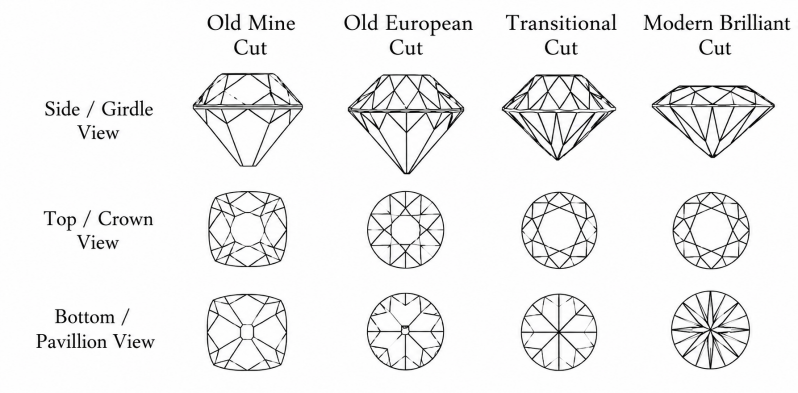
Unlike the cushion-shaped Old Mine cut, the Old European cut is distinctly round. It generally has a small table, high crown, deep pavilion, broad facets and a visible open culet. The girdle was traditionally bruted rather than faceted. Its proportions, however, were still not fully standardised, so considerable variation exists from one diamond to another.
The Old European cut usually follows the same basic 57-facet arrangement as the later round brilliant, or 58 when the culet is counted as a facet. The difference lies mainly in its proportions and facet relationships. Its table is smaller, its crown is higher, its lower-half facets are shorter, and its overall depth is often greater than that of a modern brilliant.
These features produce a very different visual effect. Rather than the rapid, evenly distributed sparkle of a modern brilliant, an Old European cut tends to show broader and more distinct flashes of white and coloured light. The visible culet often appears as a small circle or polygon at the centre of the stone, giving the diamond the characteristic appearance collectors immediately recognise.
The development of the circular outline was made possible by mechanical bruting, which allowed cutters to shape the girdle more accurately than before. Nevertheless, the stones were still largely cut and polished by hand, and cutters continued adapting their work to the individual rough diamond. As a result, two Old European cuts of the same weight can look remarkably different in diameter, depth, facet pattern and overall personality.
Old European cuts were widespread from approximately the late 1800s until the 1930s, when transitional cuts and increasingly standardised round brilliants began to replace them. They are found in some of the finest jewellery of the Belle Époque, Edwardian and Art Deco periods
The End of an Era
At the beginning of the twentieth century, diamond cutting entered a new era. Advances in machinery and precision engineering made it possible to produce diamonds with an unprecedented level of symmetry and consistency. During this period, step cuts continued to evolve, and in 1902 the Asscher brothers of Amsterdam introduced the Asscher cut, one of the most iconic geometric diamond cuts ever created. Although the emerald cut already existed, the Asscher cut refined the concept with its perfectly square outline, cropped corners and exceptional symmetry.
As we move from the Old European Cut to the Transitional Cut and finally to the Modern Brilliant, we witness the pursuit of ever greater precision and brilliance. Yet whether this also meant greater beauty is ultimately a matter of personal opinion.
Modern technology gradually eliminated many of the limitations that earlier craftsmen had to overcome. Standardisation replaced much of the individual interpretation that had characterised diamond cutting for centuries. At the same time, the diamond industry became increasingly industrialised. Production efficiency, consistency and weight retention became important economic considerations, leading to machines capable of producing thousands of diamonds to remarkably similar standards.
Much was gained. Modern brilliant-cut diamonds achieve extraordinary brilliance, exceptional symmetry and unparalleled precision.
Yet something was also lost.
Gone were the days when a master cutter could spend days studying a single crystal before making the very first facet. Armed with little more than experience, patience and primitive tools, his ambition was not to create a mathematically perfect diamond, but to reveal the unique beauty hidden within each individual stone. As the diamond industry became increasingly driven by efficiency and standardisation, the craftsman gradually gave way to the technician.
This is why no two Old Mine or Old European Cut diamonds are ever truly identical. Each reflects the decisions, skill and artistic judgement of the craftsman who created it. Their slight asymmetries, open culets, high crowns and individually balanced proportions are not imperfections; they are the signature of the human hand.
For many collectors—myself included—that individuality is precisely what gives antique diamonds their enduring charm. They are not simply gemstones; they are small works of art, each carrying the legacy of the craftsman who shaped it centuries ago
Régis
Henri Simon Antiques